Consistent Title Block Guidance Across Projects
-
ClientEmily Davis
-
CategoryProject Uniformity
-
Date01.18.2026
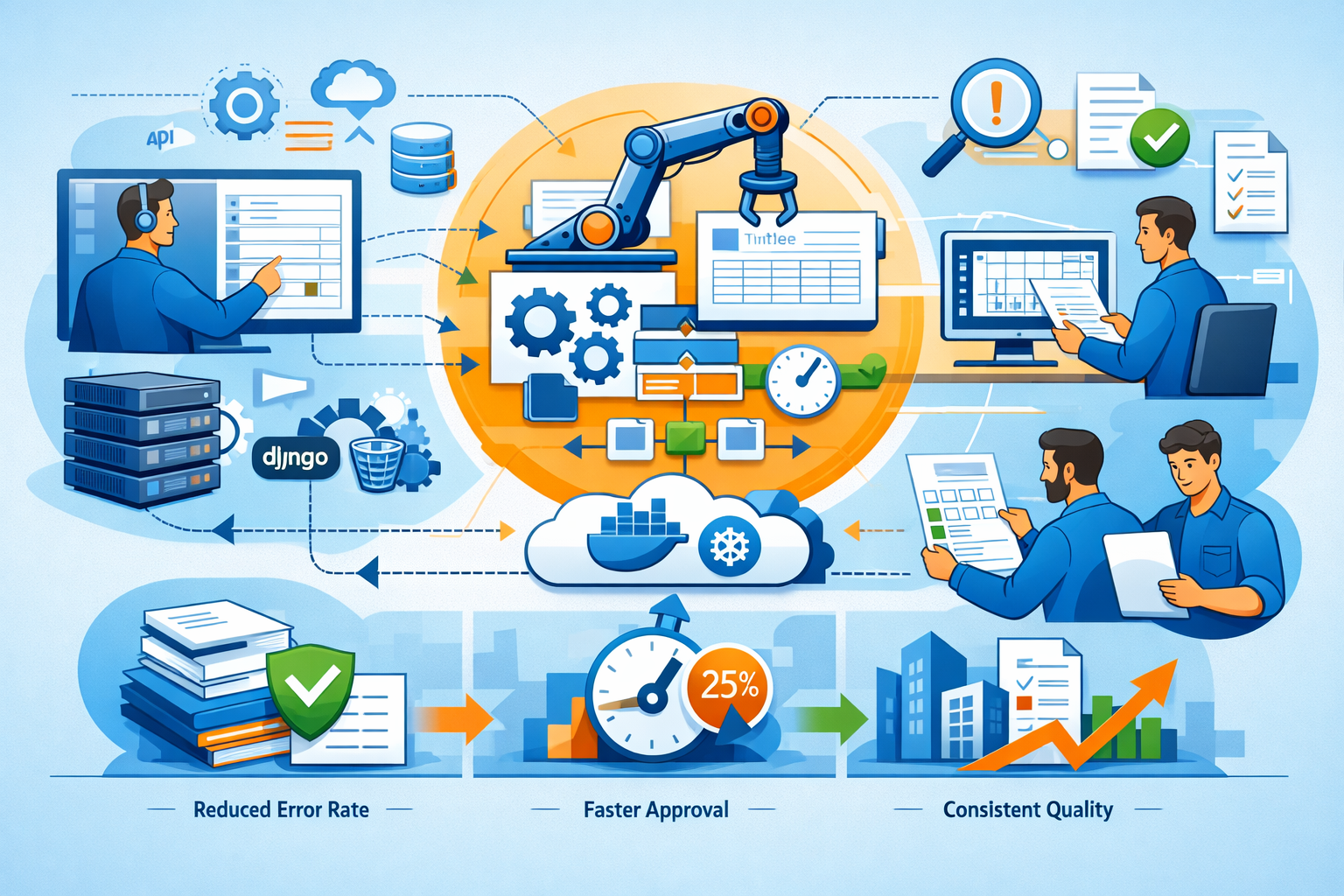
As part of our strategic development, we tackled the critical task of ensuring consistency and accuracy in the design documentation. The main problem was the lack of a centralized mechanism for managing title blocks in different projects, which led to significant discrepancies, manual errors, and the need for constant data rechecking. This not only slowed down the process of approving and issuing documentation, but also created risks for compliance with internal and external standards. Our team focused on creating an integrated solution that would automate the process of creating, applying, and controlling title blocks, thereby significantly improving the efficiency of workflows and the quality of project materials. We planned to achieve complete standardization, minimize the human factor in the formation of critical data, and accelerate the overall preparation of projects for implementation.
UX/UI design
During the user experience and interface design phase, we paid special attention to intuitiveness and efficiency. Our goal was to create a system that would be as easy as possible for engineers and project managers to learn, but at the same time would have deep functionality. We developed a centralized control panel that allows administrators to define and manage header block templates using a flexible field builder. For end users, we created an optimized workflow where the selection and application of the desired template could be done in a few clicks, with real-time preview of changes. Key aspects included: visual representation of the header block structure, dynamic validation of input data with error highlighting, and a template versioning system to track changes and ensure backward compatibility. The interface was designed to minimize cognitive load, using familiar interaction patterns and a clear information hierarchy. We implemented contextual hints and training elements to reduce the adaptation time for new users and ensure the smooth integration of the system into existing workflows.
Architectural and technological solutions
To implement the project, we chose a microservice architecture that provides high scalability, fault tolerance, and flexibility in development. The main backend was developed in Python using the Django REST Framework, which allowed us to quickly create reliable and secure APIs. A PostgreSQL relational database was chosen for data storage, capable of efficiently processing complex queries and ensuring data integrity. The frontend was implemented using React.js, which provided a dynamic and responsive user interface. A key architectural decision was the development of a dynamic validation module that allowed verification rules to be defined for each field of the header block (e.g., date formats, required fields, character length restrictions) directly through the administrative interface, without the need to change the code. We also implemented a system for integration with existing CAD and document management systems via RESTful API, which automated the export and import of header block data, ensuring seamless interaction with the company's current infrastructure. To ensure high availability and performance, the system was deployed in a cloud environment using containerization (Docker) and orchestration (Kubernetes), which allowed for efficient resource management and automation of deployment and scaling processes. Asynchronous processing of background tasks, such as mass updating of header blocks, was implemented using Celery and RabbitMQ, which significantly improved the overall responsiveness of the system.
The project was implemented in several iterative stages using the Agile methodology. The initial phase included the development of a minimum viable product (MVP) that focused on the basic functionality of creating and applying templates. Subsequent sprints were devoted to expanding functionality, integrating with external systems, and improving the user experience. Each stage of development was accompanied by thorough testing: from unit and integration tests to comprehensive system testing and user acceptance testing (UAT) involving key stakeholders from various engineering departments. This allowed us to quickly identify and eliminate defects, as well as collect valuable feedback for further improvements. CI/CD (Continuous Integration/Continuous Deployment) processes were set up to automate building, testing, and deployment, ensuring fast and reliable delivery of new features and fixes.